Book of Caverns
Ancient Egyptian underworld book detailing Ra's journey through twelve caverns.

The British Library · No restrictions
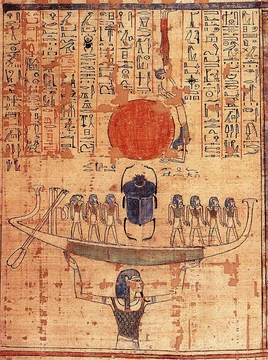
The Book of Caverns is an Ancient Egyptian underworld book from the New Kingdom, originating in the 13th century BC during the Ramesside Period. Like other underworld books, it is found in mortuary contexts such as tombs or temples, and describes the journey of the Egyptian sun god Ra through the twelve caverns of the Duat (the Egyptian underworld). The book highlights Ra's interactions with the residents of the underworld, punishing or rewarding them for their actions, and focuses on Ra's rebirth in the morning through his merging with the god of the dead, Osiris.
- Origin
- 13th century BC, Ramesside Period, Ancient Egypt
- Type
- Underworld funerary text
- First modern description
- Jean François Champollion, 1844
- Title assigned by
- Eugène Jean Baptiste Lefebvre, 1889
- First English translation
- Alexandre Piankoff, 1954
- Earliest known version
- Osireion (mortuary temple of Seti I in Abydos)
- Complete copies found at
- Osireion, tomb of Ramesses VI, tomb of Ramesses IX
Lore & Background
The earliest known version of the Book of Caverns is inscribed on the left hand wall of the Osireion, a mortuary temple to Seti I in Abydos, with only its upper register damaged. It also appears in tombs in the Valley of the Kings from the 19th and 20th dynasties, and in non-royal mortuary contexts in later periods of the New Kingdom. The first and only almost complete copy in the Valley of the Kings is in the tomb of Ramesses VI, where it is placed opposite the Book of Gates and covers the walls completely in text.
The Book of Caverns was first brought into contemporary historiography by Jean François Champollion, who described its inscriptions and images from the tomb of Ramesses VI in his 13th letter from Thebes, published in 1844. The title 'Book of Caverns' was assigned by Eugène Jean Baptiste Lefebvre in 1889. The Osireion copy was uncovered by archaeologists Margaret Murray and Flinders Petrie in 1902–1903; Murray initially interpreted it as a section of the Book of Gates. In 1954, Alexandre Piankoff published an English translated copy, which along with his articles from 1942–1958 forms the basis for current English scholarship.
Reader's Guide
The Book of Caverns is significant as one of the major Ancient Egyptian underworld books from the New Kingdom, providing insight into Egyptian beliefs about the afterlife, divine judgment, and the nightly journey of the sun god Ra. Unlike other underworld books, its six main divisions do not correspond to the twelve hours of the night or the twelve caverns, leading to frequent misinterpretation that it depicts only six caverns. The book emphasizes both the punishment of the damned and the unification of Ra with Osiris, a central theme culminating in Ra's rebirth. Scholars debate whether the primary purpose was to showcase this unity or to focus on punishing the enemies of the gods. The Book of Caverns has been found at eight sites, with complete versions only at the Osireion and the tombs of Ramesses VI and Ramesses IX. Its discovery and translation by figures such as Champollion, Murray, Petrie, and Piankoff have shaped modern understanding of Egyptian funerary literature.
Did You Know?
- The Book of Caverns was originally thought by Margaret Murray to be a section of the Book of Gates.
- The title 'Book of Caverns' was not assigned until 1889 by Eugène Jean Baptiste Lefebvre.
- The earliest known version is on the left wall of the Osireion, a mortuary temple to Seti I in Abydos.
- The book is divided into 17 sections, including six main divisions and a final rebirth tableau, but these do not correspond to the twelve caverns.
Gallery

Frequently Asked Questions
What is the Book of Caverns?
It is an Ancient Egyptian funerary text from the New Kingdom that narrates the sun god Ra's nightly passage through twelve underground caverns in the Duat. Composed during the Ramesside Period in the 13th century BC, it was painted in tombs and temples as part of mortuary decoration.
What happens in the Book of Caverns?
The text follows Ra as he moves through twelve caverns of the underworld, where he encounters the souls and deities dwelling there and judges them, punishing the wicked while rewarding the virtuous. The narrative culminates in Ra merging with Osiris so that he can be reborn at dawn.
Where is the oldest surviving copy of the Book of Caverns?
The earliest known version comes from the Osireion, the mortuary temple of Pharaoh Seti I at Abydos, making it the oldest physical witness to the text we have today.
Who first identified and translated the Book of Caverns for modern readers?
Jean François Champollion gave the first modern scholarly description in 1844, and the name 'Book of Caverns' was assigned later by Eugène Jean Baptiste Lefebvre in 1889. Alexandre Piankoff produced the first English translation in 1954.
Why is the Book of Caverns important to Egyptian theology?
It maps the structure of the Duat and explains how Ra's daily death-and-rebirth cycle sustains cosmic order. Its closing emphasis on Ra's union with Osiris ties the solar renewal myth directly to the realm of the dead, reinforcing the idea that the sun's return depends on the god of the dead.
More in Egyptian mythology 1-24
Spotted an error? Know more?
This is a living reference — every entry is fact-audited, and reader corrections feed straight into our audit queue. Suggest an edit · See this site's audit record