Abtu
Sacred fish and western direction in Egyptian myth.

Abtu (Ancient Egyptian: ꜣbḏw) is a term with multiple meanings in ancient Egyptian culture. It refers both to a sacred fish in Egyptian mythology and to the city of Abydos, the burial place of Osiris and early Egyptian rulers. As a word, Abtu also denoted the west or western direction, understood as the place where the sun finishes its daily passage and enters the dark underworld.
- type
- Sacred fish and place name
- associated_deity
- Isis, Ra, Osiris
- mythological_role
- Accompanied or towed the barque of Ra across the sky at sunrise
- related_city
- Abydos
- related_city_2
- Oxyrhynchus
- known_for
- Sacred fish; word for west; connection to Isis and Osiris myth
Lore & Background
Abtu is attested as a sacred fish in the text 'A Hymn Of Praise To Ra When He Riseth In The Eastern Part Of Heaven,' as translated by Robert Guisepi (1984), which includes the line 'Let me behold the Abtu Fish at his season.' The goddess Isis is said to have transformed into the Abtu, perhaps lending the creature its sacred state. As 'Abtu, Great Fish of the Abyss,' Isis was identified with the penis-swallower of Osiris in the legend of Osiris within the city of Oxyrhynchus, and named the city after the sacred fish (Oxyrhynchus means 'sharp nosed fish'). The fish cult spread to many parts of Egypt.
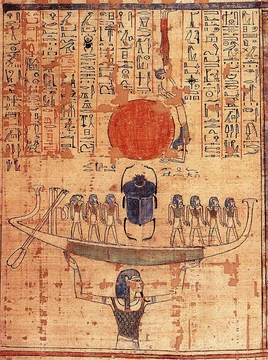
In mythology, the Abtu also was known to accompany or tow the barque of Ra across the sky at sunrise. The word Abtu itself was the ancient word for the western or west of something, understood as the place where the day's passage of the sun across the sky finishes, where the sun dies each day and passes into the dark underworld.
Reader's Guide
Abtu holds significance as a multifaceted term in ancient Egyptian culture, linking geography, mythology, and religious practice. As a word for 'west,' it connected the daily solar cycle to the concept of death and the underworld, a central theme in Egyptian cosmology. As a sacred fish, Abtu was associated with the sun god Ra, accompanying his solar barque at sunrise, and with the goddess Isis, who transformed into the fish in the Osiris myth. This association led to the naming of the city Oxyrhynchus ('sharp nosed fish') and the spread of a fish cult across Egypt. The term also designated the city of Abydos, a major burial site for Osiris and early rulers, further cementing its link to death and the afterlife. The evidence for Abtu as a sacred fish comes from a hymn to Ra, indicating its role in funerary and solar theology. The legacy of Abtu thus encompasses linguistic, mythological, and geographical dimensions, reflecting the interconnectedness of Egyptian thought.
Did You Know?
- Abtu is the name of a sacred fish in Egyptian mythology and also the name of the city of Abydos.
- The word Abtu meant 'west' or 'western,' understood as where the sun dies each day.
- The goddess Isis is said to have transformed into the Abtu fish.
- The Abtu fish was known to accompany or tow the barque of Ra across the sky at sunrise.
The West and the Dying Sun
In the ancient Egyptian conceptual framework, Abtu carried a deeply cosmological weight far beyond a simple geographic label. The term functioned as the native word for the western direction or the west side of any given thing. For the people of the Nile, this was no neutral orientation. The west represented the precise point where the sun's daily journey across the heavens came to an end. Each evening, the solar deity was understood to die at that horizon and descend into the dark underworld, where the realm of the dead lay waiting. This association with termination, darkness, and the passage beyond the visible world gave Abtu an inherently sacred and liminal quality. It was the threshold between the living sky and the hidden realm below, a boundary that structured Egyptian thought about mortality, the afterlife, and the cyclical nature of the sun's existence. The word thus encoded an entire theology of endings and transitions into a single directional concept.
The Sacred Fish and Its Cult
The Abtu was venerated as a sacred fish throughout Egyptian religious life, a status attested in liturgical texts that speak of beholding the creature at its proper season. One such reference appears in a hymn of praise to Ra at his eastern rising, translated by Robert Guisepi in 1984, where the supplicant asks to see the Abtu Fish when the time is right. This seasonal invocation suggests the fish held a ritual calendar role, tied to specific moments in the solar or agricultural year. The devotion to this creature was not confined to a single temple or region; the fish cult radiated outward and took root in many parts of Egypt, indicating a broad and enduring popular reverence. The sacred character of the Abtu was further reinforced by its mythological entanglement with the goddess Isis, whose transformation into the fish lent the animal a divine pedigree that ordinary creatures could not claim. In this way, the Abtu occupied a unique niche in the Egyptian pantheon: a living, swimming emblem of holiness whose worship stretched across the breadth of the land.
Isis, the Fish, and Oxyrhynchus
The most narratively rich thread connecting Abtu to the wider Egyptian mythological web runs through the goddess Isis. According to the surviving tradition, Isis herself transformed into the Abtu, an act that likely conferred upon the fish its sacred standing in the eyes of worshippers. In the Osiris legend as it was told within the city of Oxyrhynchus, Isis in her fish form was identified as the one who swallowed the severed penis of Osiris, a crucial act in the resurrection narrative. The city itself bore the name of this sacred creature: Oxyrhynchus, a Greek rendering meaning sharp-nosed fish, directly referencing the Abtu. This naming suggests that the local cult centered on the fish was so deeply embedded in the community's identity that the settlement took its name from the animal. The epithet Great Fish of the Abyss attached to Isis in this role underscores the creature's association with the deep, hidden waters and the mysteries of the underworld. The legend thus wove together divine transformation, sexual symbolism, and civic identity into a single, locally potent story.
Towing the Sun and Naming the Dead
In the mythological sphere, the Abtu played a direct role in the daily solar drama. The creature was known to accompany or tow the barque of Ra as it crossed the sky at sunrise, serving as a kind of divine companion in the god's morning passage. This function placed the fish at the very heart of the most important cosmic event in Egyptian theology: the sun's emergence from the underworld and its return to the living world. The sacred fish, already linked to the western horizon and the sun's nightly death, thus also participated in the eastern rebirth, completing a full cycle of solar mythology. Beyond the sky, the name Abtu also designated the city of Abydos, the most sacred burial ground in all of Egypt. It was there that Osiris himself was interred, and it was there that the earliest rulers of the land were laid to rest. The name therefore bridged the celestial and the terrestrial, connecting the fish that towed the sun to the earth where the dead kings slept.
Frequently Asked Questions
What is Abtu in Egyptian mythology?
Abtu is a sacred fish in Egyptian myth that also served as the name for the city of Abydos and as the Egyptian word for 'the west.' It carries deep symbolic weight as the direction where the sun finishes its daily arc and descends into the dark underworld.
What role does Abtu play with the sun god Ra?
In Egyptian belief, the sacred fish Abtu accompanied or towed Ra's solar barque across the sky at sunrise. This made the fish a living symbol of the sun's daily renewal and its triumphant passage through the heavens.
How is Abtu connected to the city of Abydos?
Abtu is the ancient Egyptian name for Abydos, the sacred burial ground of Osiris and the earliest dynastic rulers. The city's identity as a place of death and resurrection ties directly to the word's meaning as 'the west,' the direction of the sun's setting and the realm of the dead.
Why is Abtu associated with Isis and Osiris?
Because Abtu names the very city where Isis gathered and reassembled Osiris's scattered body, the term is intrinsically bound to their death-and-rebirth narrative. The sacred fish thus carries the emotional and theological weight of that central Egyptian myth.
What does the word 'Abtu' literally mean in ancient Egyptian?
Abtu (written ꜣbḏw in hieroglyphs) fundamentally denotes 'the west' or the western direction. In Egyptian cosmology that direction marked the place where the sun ended its daily journey and entered the dark underworld, making the word a symbol of both death and the afterlife.
More in Egyptian mythology 1-24
Spotted an error? Know more?
This is a living reference — every entry is fact-audited, and reader corrections feed straight into our audit queue. Suggest an edit · See this site's audit record