Ancient Egyptian creation myths
Diverse accounts of world creation from ancient Egypt.

Anonymous ( Egypt ) Unknown author · Public domain
The earliest known religious texts in the world come from ancient Egypt, dating back to the Old Kingdom (around 2700–2200 BC). These writings, found in the Pyramid Texts, on tomb walls, and in other records, describe how the Egyptians believed the world began. There was no single story; instead, different cities and regions had their own versions, each featuring a different creator god. In some accounts, the creator brought the world into being by spitting or masturbating.
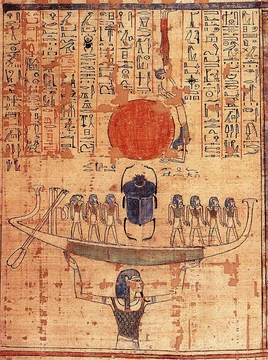
A common starting point for these myths was a state of watery chaos called Nu. From these lifeless waters, a pyramid-shaped mound known as the benben was the first thing to appear. This imagery likely came from the annual flooding of the Nile, which left behind fertile soil and created mounds of earth as the waters receded. The sun was also central to creation, often rising from this mound for the first time. It could appear as the god Ra, the scarab beetle god Khepri, or even emerge from a lotus flower in the form of a heron, falcon, or human child. Another recurring element was the cosmic egg, which sometimes stood in for the primeval waters or the mound.
The earliest gods, Ra or Atum (both creator and sun gods), emerged from chaos. Atum gave rise to Shu (air) and Tefnut (moisture). They, in turn, produced Geb (earth) and Nut (sky), who then created Osiris, Isis, Set, and Nephthys. This basic framework was expanded by the Osiris myth, in which Set murdered Osiris, and their son Horus eventually won a struggle for power. This story connected the creation of the cosmos with the Egyptian ideology of kingship. The Egyptians used the term *zp tpj* ("the first time") to describe the moment when the primordial chaos transformed into the ordered world.
Different creation accounts were tied to the cults of specific gods in major cities. In Hermopolis, the myth focused on the nature of the universe before creation. The primeval waters were represented by eight gods, the Ogdoad. These included Naunet and Nu (the stagnant water), Huh and Hauhet (infinite extent), Kek and Kauket (darkness), and Amun and Amaunet (hiddenness). Depicted as frogs (males) and snakes (females), these gods eventually converged, causing a great upheaval that produced the pyramidal mound, from which the sun rose.
In Heliopolis, creation was attributed to Atum, a god closely linked to Ra. Atum existed as an inert potential
- Earliest known sources
- Pyramid Texts, tomb decorations, writings from Old Kingdom (c. 2700–2200 BC)
- Common element
- World arose from lifeless waters of chaos called Nu
- First thing to emerge
- Pyramidal mound called benben
- Major creation centers
- Hermopolis, Heliopolis, Memphis, Thebes
- Key creator gods
- Ra, Atum, Ptah, Amun
- Associated term
- zp tpj ('the first time')
Lore & Background
The Memphite version centered on Ptah, who created the world intellectually through thought in his heart and speech by his tongue, producing the gods and all things. The Theban theology claimed Amun was the hidden force behind all things, transcending other deities; one myth likened his act of creation to the call of a goose that broke the stillness of the primeval waters. Common elements across myths include the lifeless waters of chaos (Nu), the pyramidal mound (benben), and the sun's first rising from the mound.
Reader's Guide
Ancient Egyptian creation myths are significant as the earliest recorded religious compilations in the world, providing foundational narratives for Egyptian cosmology, kingship, and theology. The myths share common elements—the primeval waters Nu, the pyramidal mound benben, and the sun's emergence—likely inspired by the annual Nile flood. Each major city's version (Hermopolis, Heliopolis, Memphis, Thebes) represented competing theologies but also different aspects of creation. The Heliopolitan Ennead and the Osiris myth linked creation to kingship ideology. The Memphite theology introduced intellectual creation by word and mind, while Theban theology elevated Amun as the hidden force behind all. These myths influenced Egyptian religion for millennia, with the term 'zp tpj' ('the first time') marking the transition from chaos to existence.
Did You Know?
- Some versions of the myth indicate spitting, others masturbation, as the act of creation.
- The pyramidal mound called benben was likely inspired by mounds of earth left after the Nile flood receded.
- The Ogdoad of Hermopolis included eight gods represented as frogs (males) and snakes (females).
- The Memphite creation myth described an intellectual creation by the Word and Mind of God, not a physical one.
Sources and Historical Significance
The primary window into how the ancient Egyptians understood the birth of the world comes from the Pyramid Texts, decorative paintings on tomb walls, and various written records. These sources trace back to the Old Kingdom period, roughly 2700 to 2200 BC, and they collectively supply the bulk of what modern scholars know about Egyptian cosmogony. What makes these materials remarkable is their age: they constitute the oldest surviving religious compilations anywhere in the human record. The myths were not a single unified narrative but a tapestry of competing and complementary accounts, each tied to a particular city and its patron deity. Some versions describe the creative act as spitting, others as masturbation, reflecting the diversity of theological thought across the Nile Valley. The term zp tpj, meaning "the first time," captured the pivotal moment when primordial chaos gave way to an ordered, existing world.
The Heliopolitan Ennead and the Lineage of Creation
In the city of Heliopolis, creation was credited to Atum, a deity intimately linked to the sun god Ra. Atum existed within the lifeless waters of Nu as a dormant, potential being, and the Heliopolitan narrative traces his evolution from a single entity into the full multiplicity of the cosmos. When Atum rose upon the pyramidal mound, he brought forth Shu, the god of air, and Tefnut, the goddess of moisture. The myth employs the metaphor of masturbation to explain this act, with the hand symbolizing the feminine principle contained within him; alternatively, he is described as sneezing and spitting to produce the pair, wordplay rooted in their names. Shu and Tefnut then united to generate Geb, the earth, and Nut, the sky, who together set the boundaries of the world. Their union yielded four offspring representing vital forces: Osiris of fertility and regeneration, Isis of motherhood, Set of chaos, and Nephthys of protection. These nine deities formed the Ennead, while all other things in existence were regarded as extensions of Atum himself.
The Memphite Intellectual Creation
The creation theology of Memphis offered a strikingly different vision. Centered on Ptah, the patron deity of craftsmen, this account framed the birth of the world not as a physical act but as an intellectual one. Ptah embodied the artisan's capacity to conceive a finished object in the mind and then shape raw materials into that vision. In the Memphite telling, the ideas that formed within Ptah's heart—the Egyptians considered the heart the seat of thought—were given concrete form when he spoke their names aloud with his tongue. By uttering these names, Ptah brought the gods and every other element of existence into being. This creative speech was not separate from the Heliopolitan tradition; rather, Ptah's thought and utterance were understood to have produced Atum and the entire Ennead. Ptah was additionally linked to Tatjenen, the deity who personified the pyramidal mound from which the sun first emerged. The Memphite myth thus positioned intellectual conception as the ultimate source behind even the most physical of creation narratives.
The Hermopolitan Ogdoad and the Nature of Primordial Chaos
The theological school of Hermopolis turned its attention to what existed before creation itself. The inherent qualities of the primeval waters were personified by a group of eight deities known as the Ogdoad. Naunet and her male counterpart Nu embodied the stagnant water; Huh and Hauhet represented its boundless extent; Kek and Kauket gave form to the darkness within it; and Amun and Amaunet captured its hidden, unknowable character, standing in contrast to the tangible world of the living. Because the waters were themselves part of the creative process, these eight could be regarded as creator gods. The myth describes them as originally split into male and female groups, symbolically depicted as frogs and snakes respectively, reflecting their aquatic dwelling. When the two groups converged, the resulting upheaval produced the pyramidal mound, from which the sun rose to illuminate the world.
Gallery
Frequently Asked Questions
What are Ancient Egyptian creation myths?
They are a set of diverse narratives describing how the world came into being, with no single canonical version. They survive in the Pyramid Texts, tomb wall inscriptions, and other Old Kingdom writings dating to roughly 2700–2200 BC, making them among the oldest religious texts known to us.
Who are the main creator gods in Egyptian creation myths?
The principal creator figures include Ra, Atum, Ptah, and Amun, each championed by a different city or theological center such as Heliopolis, Memphis, or Thebes. In some tellings, the god brought the world into being through acts like spitting or self-generation.
What is Nu in Egyptian creation myths?
Nu is the primordial, lifeless body of water that represents the state of chaos before anything existed. Most Egyptian creation stories begin with this formless watery void, from which the first solid ground eventually rises.
What is the benben mound in Egyptian mythology?
The benben is the pyramidal-shaped mound of earth that is the first solid thing to emerge from the chaotic waters of Nu. It serves as the starting point for all subsequent creation in most Egyptian cosmogonic accounts.
Why are there multiple Egyptian creation myths instead of one?
Different cities and priestly schools each elevated their own patron deity as the supreme creator, so Hermopolis, Heliopolis, Memphis, and Thebes all produced distinct versions. This multiplicity reflects local theological rivalries rather than a single unified doctrine.
More in Egyptian mythology 1-24
Spotted an error? Know more?
This is a living reference — every entry is fact-audited, and reader corrections feed straight into our audit queue. Suggest an edit · See this site's audit record