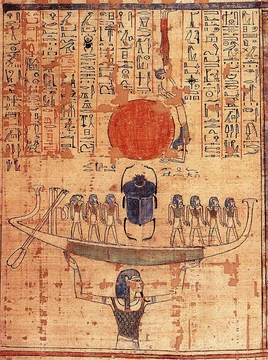
Ankh
Ancient Egyptian hieroglyphic symbol for life.

Jl FilpoC · CC BY-SA 4.0
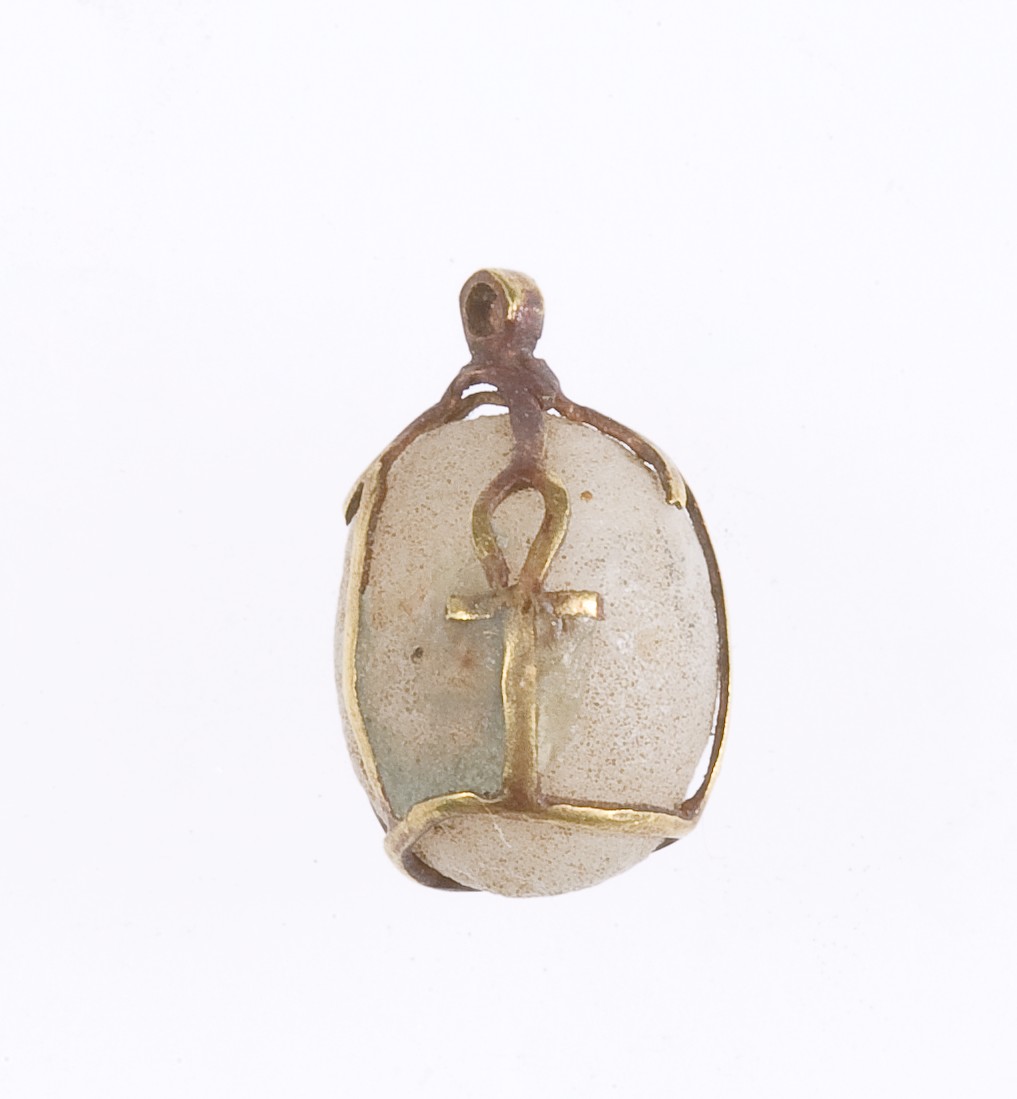
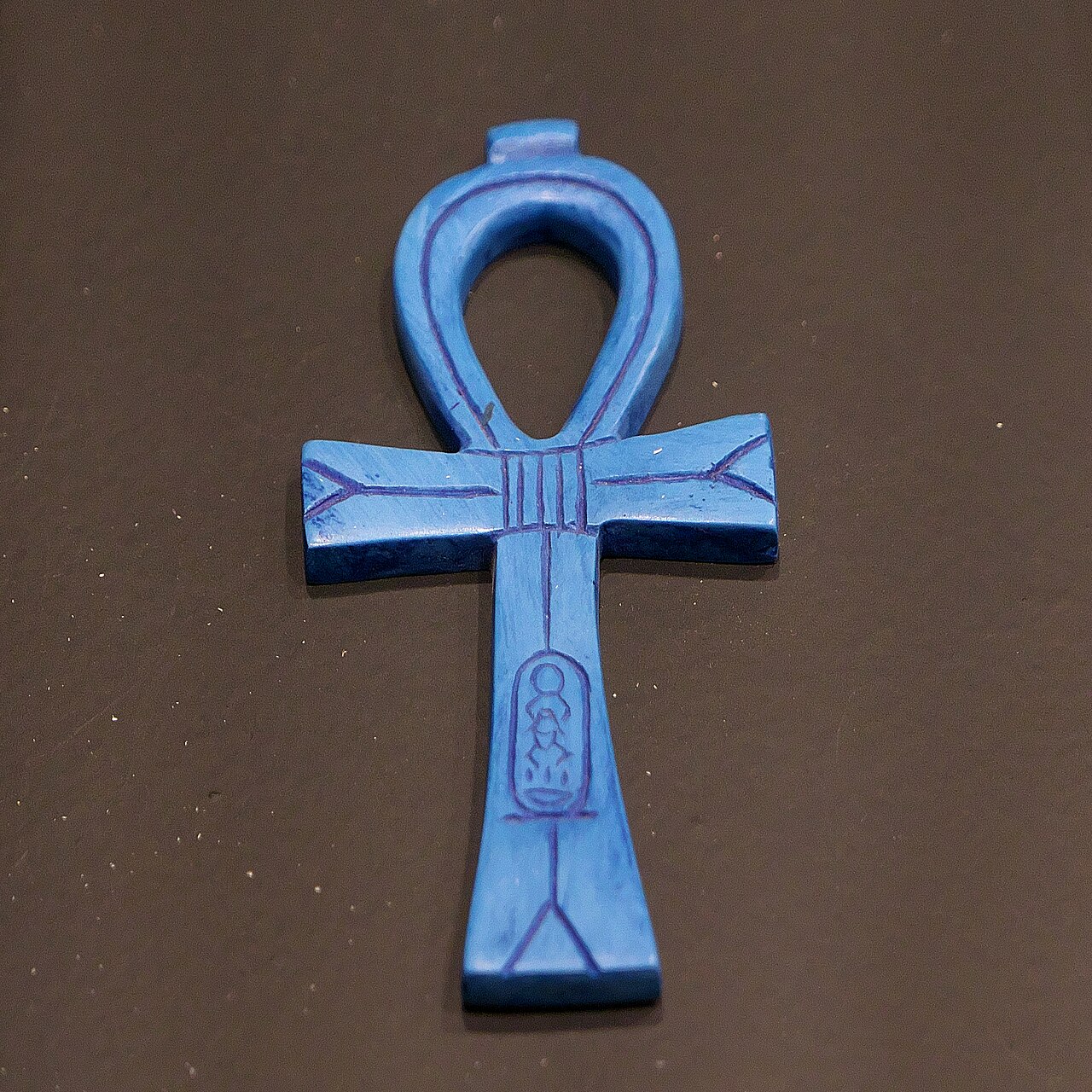
The ankh, also known as the key of life, is an ancient Egyptian hieroglyphic symbol representing the word for 'life' and, by extension, life itself. It has a T-shape topped by a droplet-shaped loop and was used as a triliteral sign for the consonants Ꜥ-n-ḫ. The ankh appears frequently in Egyptian art, often held by deities to signify their power to sustain life and revive souls in the afterlife.
- type
- Hieroglyphic symbol
- period
- First Dynasty (c. 30th–29th century BC) onward
- language
- Egyptian
- meaning
- Life
- consonants
- Ꜥ-n-ḫ
- also_used_for
- Mirror, floral bouquet, sandal strap (disputed)
Lore & Background
In ancient Egyptian hieroglyphic writing, the ankh was a triliteral sign representing the consonant sequence Ꜥ-n-ḫ. This sequence appeared in words for 'live', 'life', 'mirror', 'floral bouquet', and 'oath'. The sign is known in English as 'ankh' based on the hypothetical pronunciation of the Egyptian word, or as 'key of life' based on its meaning. Early examples date to the First Dynasty, but there is little agreement on what physical object the sign originally represented. Many scholars believe it was a knot of flexible material, and early versions resemble the tyet symbol for 'protection'. Egyptologist Alan Gardiner argued the sign originated as a sandal strap, a hypothesis that persists in some introductory texts. Other theories suggest a sexual meaning, a mirror, or a thoracic vertebra of a bull.
Reader's Guide
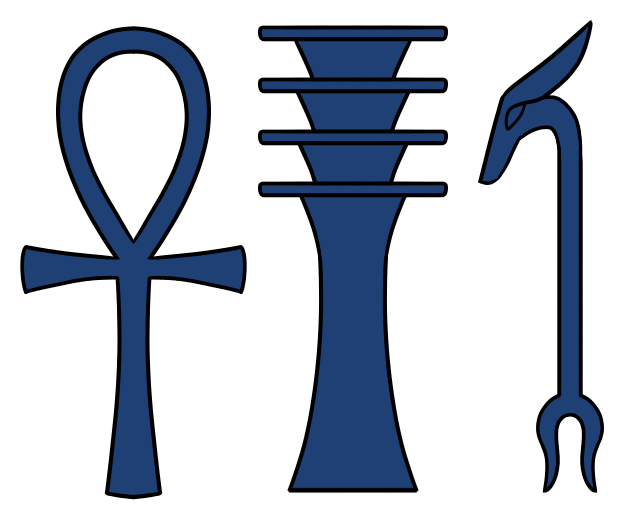
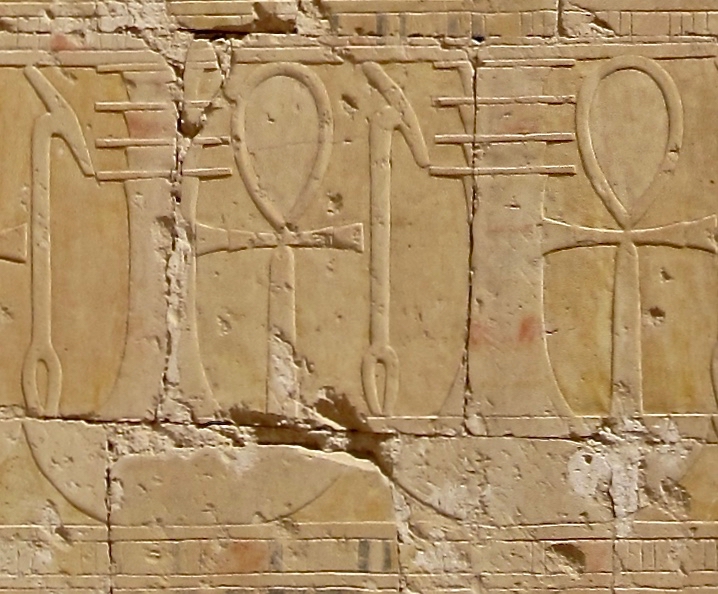
The ankh was a widespread decorative motif in ancient Egypt, used in temple friezes, on mirrors, libation vessels, and sistra. It often appeared with the was-sceptre and djed pillar to signify 'life, dominion, and stability'. In religious art, gods held the ankh to the nose of the pharaoh, offering the breath of life, and chains of ankh signs could replace water in purification scenes. The symbol was also used decoratively by neighbouring cultures. Copts adapted it into the crux ansata, a variant of the Christian cross with a circular loop. In Western culture, the ankh came into widespread use in the 1960s as a symbol of African cultural identity, Neopagan belief systems, and later the goth subculture. Its enduring legacy lies in its representation of life and its adoption across diverse cultural contexts.
Did You Know?
- The ankh was a triliteral sign representing the consonants Ꜥ-n-ḫ.
- The same consonants appear in the Egyptian words for 'mirror' and 'floral bouquet'.
- Early versions of the ankh show the lower bar as two separate lengths of flexible material, suggesting a knot.
- The ankh was adapted by Copts into the crux ansata, a variant of the Christian cross.
Linguistic Architecture of the Sign
The ankh functions as a triliteral hieroglyphic sign, encoding the consonant sequence ꜥ-n-ḫ. The middle sound corresponds to the familiar English "n," while the first is a voiced pharyngeal fricative and the last a velar fricative—neither of which exists in modern English phonology. This single sign served multiple words in the Egyptian lexicon: the verb "to live," the noun "life," the derived term sꜥnḫ meaning "cause to live" or "nourish," the word for "mirror," and the term for a floral bouquet. In the Coptic stage of the language, ꜥnḫ evolved into ōnh. Egyptologists Battiscombe Gunn and Alan Gardiner catalogued the sign as S34 in Gardiner's list, slotting it within the clothing category immediately after S33, the sandal hieroglyph. The sign's English name "ankh" derives from a hypothetical reconstruction of the Egyptian pronunciation, while "key of life" reflects its semantic content. The same three consonants also composed the word for a looped rope-like object depicted on Middle Kingdom coffins, which Gunn and Gardiner interpreted as sandal straps based on their paired placement at the coffin's foot and accompanying texts describing them as resting "on the ground under his feet."
Origins and Scholarly Contention
The earliest ankh signs appear in First Dynasty contexts, roughly the 30th to 29th century BC, yet their physical referent remains contested. Heinrich Schäfer and Henry Fischer proposed the sign depicts a knot of cloth or reeds, noting that early renderings show the lower bar as two separate flexible strands resembling a tied knot, and drawing a parallel to the tyet symbol for "protection." Alan Gardiner advanced a rebus-principle explanation: the sign originally pictured sandal-strap knots and was then extended phonetically to every word containing ꜥ-n-ḫ. James P. Allen's 2014 introductory grammar still treats "sandal strap" as the sign's primary meaning. Other scholars have proposed very different origins. Thomas Inman, a nineteenth-century amateur mythologist, read the shape as a fusion of male and female reproductive organs. Victor Loret argued for "mirror" as the original referent, though he acknowledged the difficulty of deities gripping the ankh by its loop where a solid reflective surface would block their hands. Andrew Gordon and Calvin Schwabe linked the ankh to bull anatomy, pairing it with the was-sceptre and djed pillar as representations of a thoracic vertebra, sacrum, and dried penis respectively, grounded in Egyptian beliefs connecting semen to life and power.
Sacred Function in Egyptian Religion
In Egyptian cosmology, life was understood as a circulating force permeating the entire world. The ankh served as the visual embodiment of that force, appearing in art not merely as an abstract glyph but as a tangible object—sometimes representing life itself, sometimes a life-giving substance such as air or water. Deities are routinely depicted holding the ankh by its loop, and in countless scenes they extend it toward the pharaoh, a gesture encoding their authority to sustain living beings and to reanimate human souls in the afterlife. The word ꜥnḫ also carried social and ritual weight beyond the divine realm. A phrase roughly equivalent to "may you be healthy and alive" functioned as a polite formula in everyday speech, comparable to the English "if you please." The compound honorific ꜥnḫ wḏꜣ snb, meaning "alive, sound, and healthy," was the standard formula invoked whenever the pharaoh's name appeared in written texts. Even the Egyptian word for "oath" was ꜥnḫ, since sworn declarations in ancient Egypt opened with a form of the word "live," binding the speaker's very existence to the truth of the statement.
Transformation Across Cultures and Centuries
Beyond Egypt's borders, the ankh proved remarkably adaptable. Neighbouring cultures adopted it as a decorative motif, and the Coptic Christian community reshaped it into the crux ansata, substituting a circular loop for the original droplet form and employing it as a variant of the Christian cross. This Christianized form preserved the sign's association with life while recontextualizing it within a new theological framework. The symbol's modern Western visibility surged in the 1960s, when it surfaced as an emblem of African cultural identity, a nod to the continent's deep historical connection with the hieroglyph. It subsequently found a place within Neopagan belief systems, where its connotations of life-force and spiritual vitality resonated with emerging spiritual practices. Later still, the ankh became a recognizable icon in the goth subculture, its stark T-shaped silhouette and looped top lending it an aesthetic that fit the movement's visual language. Across these diverse appropriations, the ankh has continuously shed and acquired meanings, yet its core association with life and vitality—rooted in a four-thousand-year-old Egyptian writing system—has remained its most persistent thread.
Gallery

Frequently Asked Questions
What is the Ankh?
The Ankh is not a god or a character but a hieroglyphic sign that stands for the concept of life itself. It functions as a triliteral consonant cluster (Ꜥ-n-ḫ) in the Egyptian writing system and is often nicknamed the 'key of life' in modern popular usage.
What does the Ankh look like?
It has a cross-shaped body topped by a rounded, teardrop-shaped loop, a form many people compare to a crutch or an ornate key. That silhouette stayed remarkably consistent from its earliest carvings all the way through the end of the pharaonic era.
Who is typically shown holding the Ankh in Egyptian art?
Deities are the figures most often depicted gripping the symbol and extending it toward a pharaoh or another mortal. The gesture signals that the god is bestowing continued existence or the power to raise a soul in the afterlife.
How old is the Ankh symbol?
Its earliest known appearances date to the First Dynasty, roughly the 30th or 29th century BC, making it one of the oldest recognizable signs in the Egyptian script. It persisted in temple reliefs, tomb paintings, and personal jewelry for more than three millennia.
Why is the Ankh important in Egyptian mythology?
Because it visually encodes the very idea of life, it became the central icon for divine sustenance, resurrection, and the eternal cycle of existence. Seeing it in a deity's hand is essentially a shorthand for 'this god holds authority over whether you live or die.'
More in Egyptian mythology 1-24
Spotted an error? Know more?
This is a living reference — every entry is fact-audited, and reader corrections feed straight into our audit queue. Suggest an edit · See this site's audit record